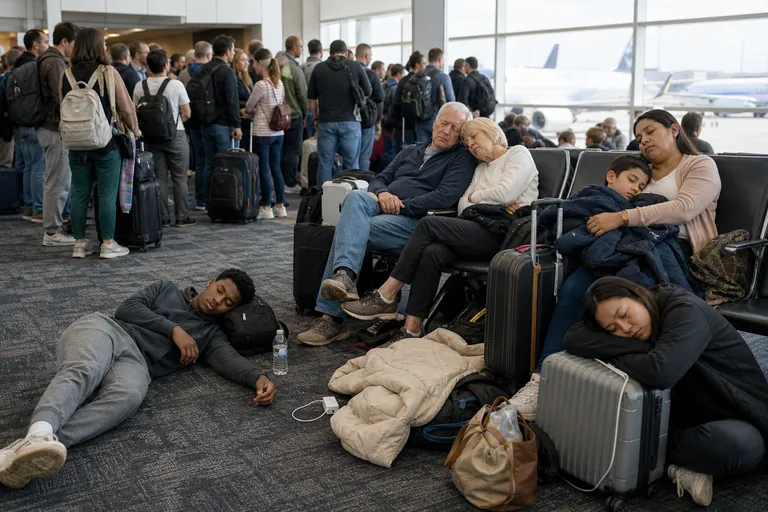
Travel Delay Coverage: What Qualifies and What It Pays

Travel delay coverage reimburses your out-of-pocket expenses (hotel, meals, taxis, essentials) when your trip is held up past a minimum number of hours (usually 3 to 12, depending on the plan) by a covered cause like weather, mechanical breakdown, or a strike. It pays up to a daily cap and an overall maximum, and you'll need receipts.
It's the least glamorous benefit in a travel insurance policy. It's also the one you're statistically most likely to use. Nobody plans to spend a night in the Dallas airport. Plenty of people do anyway.
What does travel delay coverage pay for?
When a covered delay strands you, the benefit reimburses the reasonable expenses the delay forces on you:
- A hotel room for the night, instead of an airport chair
- Meals while you wait
- Ground transportation, the taxi to that hotel and back
- Sometimes toiletries and other essentials, and on some plans the unused portion of prepaid arrangements the delay cost you
Note the word reimburses. You pay first, keep the receipts, and file a claim when you're home. Nobody hands you cash at the gate. That's a mild nuisance, but it's also why this benefit is straightforward to collect on when you've kept your paperwork, the losses are concrete, documented, and easy for a claims examiner to verify.
Picture the standard version of this story. A couple is connecting through Dallas on their way to Jamaica when an ice storm rolls in and grounds everything overnight. The airline calls it an act of God and offers nothing but a rebooked flight the next afternoon. Their travel delay benefit turns that into a hotel room, a hot dinner, and cab fare both ways — reimbursed after the trip. Not Jamaica. But a bed.
What counts as a covered delay?
Travel insurance is named-peril coverage, and travel delay is no different: the cause of your delay has to appear in the policy. The usual list is reassuringly broad. Commonly covered causes include:
- Common carrier delays, your airline, cruise line, or railroad is late or grounded for any reason attributable to the carrier, including mechanical breakdown
- Severe weather that prevents your carrier from departing, or closes the route by government order
- Unannounced strikes
- Natural disasters
- Quarantine of you or your traveling companion
- Lost or stolen passports, travel documents, or money
- A traffic accident en route to your departure point, one you weren't necessarily even involved in, on many plans
- Hijacking, civil disorder, or riot
Now the other half. The delay has to be outside your control. Overslept? Not covered. Car ran out of gas on the way to the airport? Not covered. Lingered too long at the duty-free and missed boarding? Definitely not covered. The line the policies draw is simple: things that happened to you qualify, things you did to yourself don't.
What are the minimum delay thresholds?
Every plan sets a minimum number of hours your travel must be delayed before the benefit switches on — and this threshold is one of the most useful numbers for comparing policies. Across the market it ranges from about 3 hours on generous plans to 12 hours on stingier ones, with 5, 6, and 8 in between.
The difference is not academic. A 4-hour weather delay that wrecks your evening and forces a missed dinner reservation pays nothing on a 12-hour-threshold plan. On a 3-hour plan, it's a claim. When two policies look identical on the big benefits, the delay threshold is often where the cheap one shows its seams.
While you're in the policy details, check three more numbers:
- The per-day cap, often $100 to $300 per person per day
- The overall maximum, commonly $500 to $1,000+ per person
- The threshold itself — those 3 to 12 hours
How do the per-day and maximum caps work together?
The two limits stack, and a long delay can exhaust them. Say your plan pays up to $200 per day with a $500 maximum, and a volcanic ash cloud grounds you for three days:
- Day 1: $170 hotel + $95 meals = $265 → plan pays $200 (the daily cap), you eat $65
- Day 2: $95 hotel + $70 meals = $165 → fully reimbursed
- Day 3: $120 hotel + $45 taxi + $80 meals = $245 → only $135 left under the $500 maximum, so that's what pays
Total reimbursed: $500 of roughly $675 spent. Most of the pain absorbed, not all of it. On a multi-day delay — a blizzard week, an airspace shutdown — a low-limit plan runs dry fast, which is worth remembering if you're traveling in storm season. Two other quirks: many plans pay some benefits only once per trip even if you're delayed twice, and any refunds or compensation your travel suppliers give you get deducted from the claim.
What do the airlines actually owe you?
Less than most travelers assume. US airlines don't guarantee their schedules, and for delays caused by weather, air traffic control, or anything they classify as outside their control, they're not legally required to compensate you at all. No hotel, no meals, no cash. Some airlines choose to hand out vouchers when the delay is their fault (a mechanical issue, a crew problem) but for the classic overnight weather strand, the counter agent's answer is a rebooking and a shrug.
That gap between what the delay costs you and what the airline owes you is exactly the space travel delay coverage fills. And it's why "the airline will take care of us" is one of the more expensive assumptions in travel.
When does the coverage apply?
Travel delay coverage is in force while you're en route, starting when you leave home on your scheduled departure date, through your connections and layovers, all the way to the trip home. Delayed on a layover mid-trip? Covered, same as day one, as long as the cause qualifies.
What it doesn't cover is trouble before the trip starts. If your kid spikes a fever three days before departure, that's not a delay, that's a potential cancellation, and it lives under trip cancellation coverage with its own rules. The neighboring benefits matter here too: if a delay makes you miss a cruise or tour departure, missed connection coverage handles the catch-up costs, and if a delay effectively ends your trip, trip interruption takes over. Policies coordinate these so you can't collect twice for the same loss — travel delay benefits can't duplicate what missed connection already paid.
What documentation do you need?
Receipts, and proof of the cause. That's the whole recipe, and gathering it in the moment is ten times easier than reconstructing it later.
- For the expenses: itemized receipts for the hotel, meals, and transport. Credit card statements help but itemized receipts are better.
- For a carrier delay or weather: a delay confirmation from the airline or railroad. Ask at the counter, they print these all day long and won't blink.
- For a traffic accident: a police report. If you were just stuck behind it, note the time and location and request the report afterward.
- For quarantine: a doctor's note.
- For a natural disaster, terrorism, or civil disorder: your itinerary plus news reports usually match the facts, but call the insurer and ask what they want.
Then file when you're home. The full walk-through (forms, deadlines, common mistakes) is in our guide to filing a travel delay claim.
One habit worth adopting: when a delay starts looking serious, book your hotel early and keep it reasonable. "Reasonable expenses" is the policy standard, and a modest airport hotel sails through claims review in a way a five-star suite might not.
Frequently asked questions
What does travel delay coverage reimburse?
Reasonable expenses caused by a covered delay: hotel accommodations, meals, ground transportation, and often essentials, up to your plan's per-day cap and overall maximum. Some plans also reimburse prepaid arrangements the delay made you forfeit. You pay out of pocket, keep itemized receipts, and file for reimbursement after the trip.
How long does a delay have to last before coverage kicks in?
It depends on the plan, minimum thresholds run from 3 hours on generous policies to 12 hours on basic ones. The delay must also be caused by something on the policy's covered list, like carrier problems, severe weather, strikes, or a traffic accident en route to departure. Check both numbers before you buy; they vary more than people expect.
Do airlines have to compensate me for a delayed flight?
For weather and most other delays, US airlines owe you nothing — no hotel, no meals, no cash. They don't guarantee their schedules. Some voluntarily provide vouchers for delays within their control, like mechanical problems, but it's discretionary. Travel delay coverage exists precisely because the airline's legal obligation is so much smaller than the delay's actual cost.
Does travel delay coverage apply on the way home?
Yes. The coverage is in force whenever you're en route on your covered trip, heading out on departure day, on layovers mid-trip, and on the journey home. A covered overnight delay at a connecting airport on your return is claimable the same as one on day one.
What's the difference between travel delay and missed connection coverage?
Travel delay pays your waiting costs (hotel, meals, transport) while you're stuck. Missed connection pays the catch-up costs when a delay makes you miss the next leg of your trip, classically transportation to meet your cruise at its next port. They're separate benefits with separate limits, and policies prohibit collecting from both for the same expense.
Will travel delay coverage pay if I miss my flight because I overslept?
No. The delay must be outside your control and traceable to a covered cause. Oversleeping, running out of gas, misreading your itinerary, or cutting a layover too close are all on you. A traffic accident blocking the highway to the airport, though, that's the kind of uncontrollable cause these policies are written for.
Is travel delay included in most plans, or is it an add-on?
It's a standard benefit in comprehensive package plans — including every plan sold on TripInsurance.com — rather than an add-on. Travel medical-only plans generally don't include it. What varies between plans is the threshold, the per-day cap, and the maximum, so that's where to focus when comparing.